RecSciPod S01E12 full transcript
Timestamps:
- 0:00 Intro
- 1:12 Philosophical razors
- 17:23 Egg unboiling study
- 24:36 Sound taste study
- 36:04 What did you learn today, outro
Intro
Lu: Hi
Tirth: How
Lu: What’s hi how?
Tirth: Well, how are you?
Lu: What? Welcome everybody to another episode of Recreational Science, the podcast where we explore creativity in science by examining some of the funniest, wackiest, and most provocative studies ever done. I’m Lu.
Tirth: And I’m Tirth.
Lu: Listeners, please join us on our journey where two so-called scientists explore so-called science. Is that good?
Tirth: I like the one from last episode better. What was it?
Lu: Laughable. Two laughable scientists discuss laughable science.
Tirth: Yeah.
Lu: Okay, that one’s better? Okay, we’ll keep workshopping it.
Tirth: Okay, that’s fine. We should have our listeners or our so-called listeners chime in.
Lu: Mmm, start a poll. Oh, maybe. But what if they vote for something we don’t like?
Tirth: Well, we don’t have to listen to them. It’s not a democracy.
Lu: Oh, it’s not. Okay, I see.
Tirth: No, of course not.
Lu: Good, good, good.
Tirth: Also, we can easily rig the polls, man. It’s not that hard.
Lu: That’s true.
Tirth: Stop the count, as they say.
Lu: Yes. Very good.
Philosophical razors
Lu: Tirth, I want to discuss something very near and dear to my heart today. Something that’s very important to all scientists. Philosophical razors. Are you a fan?
Tirth: Oh, big fan. Big fan. Huge fan.
Lu: Philosophical razors. Where are they?
Tirth: Well, I don’t know the formal definition, but the way I’ve always understood them is that it’s like a statement or a phrase that’s like a general rule of thumb. What they call a heuristic.
Lu: Yeah, exactly. I think that is basically the definition. There are these general, like you said, general rules of thumbs that we scientists, and really everybody should, use…
Tirth: Yeah, even in their day to day life, it’s applicable.
Lu: Yeah, to rule out unlikely explanations for things. So say you have a question like, why does the apple fall from the tree? Why are cats so mean? How come Tirth’s beard never grows? These are questions, and each of these questions has a near infinite number of possible answers, possible explanations. The razors, what they do is they help shave off the unlikely answers, which is why they’re called razors. So as scientists, we get to only focus on the most likely ones. So they’re very, very helpful, and we use them all the time.
Tirth: And by the way, I use a literal razor in my beard.
Lu: So that’s why they’re…okay.
Tirth: Let’s extend the explanation and analogy.
Lu: You’re saying that’s one of the likely explanations.
Tirth: No, that is the only explanation.
Lu: No.
Tirth: In this situation.
Lu: No, please, let’s be scientific about this. This is your hypothesis. This is one possible explanation. We don’t have evidence.
Tirth: It’s a more likely explanation. How about that? Most likely explanation.
Lu: One of. One of.
Tirth: Okay, what’s your alternative hypothesis? Let’s hear it.
Lu: Don’t make me say it, please.
Tirth: No, please, go ahead. I want to hear it now.
Lu: You know, there’s some rumors that – this isn’t coming from me. This is coming from the wind. It’s blowin’ in the wind, as Bob Dylan says – that, you know, maybe it’s not a real beard.
Tirth: Oh, is that right? I thought we settled this many episodes ago.
Lu: Actually, we did not, now that you bring it up. I’m very glad you brought it up, because you did promise on air to, what was it, tug on your beard, attempt to pull it off? But you never did.
Tirth: Should we do it now?
Lu: I wonder why.
Tirth: I’m ready to do it now, baby. Let’s go.
Lu: I’m waiting.
Tirth: Look, look, nothing’s coming off. Nothing’s coming off.
Lu: Okay. So there’s some supporting evidence that maybe it’s a real beard.
Tirth: Yeah.
Lu: We’ll say it’s a working theory.
Tirth: Sure. Sure.
Lu: Anyways, we’re talking about philosophical razors.
Tirth: Right.
Lu: So there are many of them. I picked out a few that I wanted to discuss today. Again, because these are things that scientists all use, that’s a whole reason. There aren’t any ulterior motives for this segment. So the first philosophical razor I want to discuss is called Newton’s flaming laser sword.
Tirth: By the way, what are the sources? Can you reveal the sources where you found these razors?
Lu: Legitimate sources, all of them. Philosophical Monthly – it’s a good magazine; I subscribe to it. Wikipedia – very legitimate. ESPN Plus.
Tirth: Oh, yeah. The plus makes it more legit.
Lu: Yeah, yeah, yeah. Exactly. So the first razor, Newton’s flaming laser sword, I want you to fill in the blank. I’m going to read it to you. I want you to fill in the blank.
Tirth: Go ahead.
Lu: “If something cannot be settled by experiment or observation, then it is _____.”
Tirth: “Not worthy of discussion or debate.”
Lu: Yeah, that’s correct. That’s correct. This is a very fundamental razor to science. Basically, it adds on and encapsulates the scientific principle of empiricism. Scientific discussions should be based on things that can be proven by evidence. Let me just give you an example.
Tirth: Go ahead.
Lu: Tirth, let’s say the question is – just out of thin air – does Tirth have a fiancée? This is a scientific question and the claim, I think, is yes. Is that right?
Tirth: Definitely. It’s not just a claim. It’s been proven without a reasonable doubt.
Lu: The claim is yes. This is again, this is a hypothesis, right? Tirth has a fiancée. Now, I haven’t seen any evidence supporting this hypothesis, which doesn’t mean there isn’t any. It’s just that, you know, I find it pretty weird that as one of your very good friends, I have never seen any evidence of this person that you love so dearly.
Tirth: You’ve seen pictures on Instagram…
Lu: We’ll get to that. We’ll get to that.
Tirth: Okay. Okay.
Lu: And that’s all fine. Doesn’t mean there isn’t any evidence. But now, if you were to tell me, it’s impossible to provide any evidence for the existence of your fiancée because she lives in a very far away land…
Tirth: She does.
Lu: …has no access to telecommunications whatsoever, then this isn’t really a scientific question because there’s no way to prove or disprove it using evidence, right? So I can say this isn’t worth my time. I don’t want to discuss this because it’s not scientific.
Tirth: Okay, that’s fair.
Lu: So that’s Newton’s flaming laser sword. The next razor is called Hitchens razor.
Tirth: Okay.
Lu: “That which can be asserted without evidence can be _____ without evidence”.
Tirth: “Refuted.”
Lu: Yeah, essentially. “Dismissed” is the word. “That which can be asserted without evidence can be dismissed without evidence.” So this is very similar to the razor we just did. But here, it emphasizes that the burden of proof is on the person making the claim.
Tirth: Right.
Lu: You make a claim, you need to show evidence for it. So let me give you another example. Actually, let’s just use the first example again.
Tirth: Okay, go ahead.
Lu: Tirth, again, you claim to have a fiancée.
Tirth: I do.
Lu: Interesting hypothesis. Interesting. For me to believe that you have a fiancée, Tirth, because you’re the one claiming it, you have to show evidence.
Tirth: Yeah, and it’s on Instagram.
Lu: Otherwise, I don’t have to believe you. I don’t need to show evidence disproving that you have a fiancée. The burden of proof is not on me, it’s on you. And if you don’t provide evidence, I don’t have to believe in your claim.
Tirth: Hey, it’s like when you say you’re environmentally conscious and very culturally savvy, you know.
Lu: I am. Tirth, please. Please. I have a lot of evidence. Very cultured. You know, I drink matcha. Sometimes I’ll wear a V-neck t-shirt.
Tirth: Wow. I haven’t seen that. Something I’ve not seen before.
Lu: I’ve been to Europe.
Tirth: Oh, even I haven’t been to Europe. How many times have you been to Europe, Lu?
Lu: Once. Just once.
Tirth: And for how long?
Lu: Like two days. But it was a very gay part of Europe. Very gay.
Tirth: Oh, okay. So you got extra points, bonus points.
Lu: Even for Europe, this was quite gay.
Tirth: Bonus points.
Lu: Yeah. I went there for Swap’s wedding. Shout out Swap. Lovely wedding, by the way. Which is to say, going to this very gay place in Europe is equivalent to going to anywhere else in Europe, at least like a dozen times.
Tirth: Yeah. Fair enough.
Lu: Yeah. So I’ve been to Europe like 15 times, at least.
Tirth: Okay. Wow. So cultured.
Lu: Tirth, please check yourself before you wreck yourself.
Tirth: That’s more than the number of times you’ve been in Los Angeles.
Lu: That’s true. Yeah. That’s how cultured I am.
Tirth: I stand corrected.
Lu: Thank you. Thank you. What are we doing? Oh, razors. Razor number three. This one’s called the Sagan standard, named after Carl Sagan. “Positive claims require positive evidence. ______ claims require _____ evidence.”
Tirth: “Extraordinary claims require extraordinary evidence?”
Lu: Exactly. Perfect. “Extraordinary claims require extraordinary evidence.” This razor encapsulates the scientific principle of skepticism. The bigger the claim, the bigger the evidence you need, the more evidence you need. Going back to our example, you make this claim that you have a fiancée.
Tirth: Not an extraordinary claim. Moderate claim.
Lu: Please, Tirth. This is a huge claim. A huge claim. In fact, I find it really hard to believe. Given what I know about you and given how awesome of a person you make her sound, I find it very hard to believe. Extraordinary claim. Therefore, I need extraordinary evidence. And if the only evidence you can provide me is an obviously AI generate a photo of a woman standing next to you – by the way, she had eight fingers in that picture. You should have counted.
Tirth: Hey man, she has a medical condition, okay? Don’t make fun of her.
Lu: Please, Tirth. If that’s the only evidence you can provide me, then I’m going to have some doubts. I need better evidence.
Tirth: Like for example, you need to see her in person.
Lu: Yeah.
Tirth: You need to touch her. You need to put your fingers on her face and try pulling her hair.
Lu: Please, Tirth. Just some evidence of life is enough, okay? We don’t need to get too creepy, okay?
Tirth: Just check her pulse…
Lu: The next razor is called Popper’s falsifiability criterion.
Tirth: Okay.
Lu: So “for a theory to be considered scientific, it must be _____.”
Tirth: “Falsifiable.”
Lu: “Falsifiable.” Exactly.
Tirth: Yeah, it’s Karl Popper.
Lu: So this is super important. What it says is a hypothesis can’t just be supported by evidence for it to be considered scientific. It also has to be falsifiable. There has to be a reasonable chance that it can be proven wrong.
Tirth: Yeah.
Lu: If it’s something that’s impossible to prove wrong, then it’s not scientific. This means that if you make a theory, you should test it using experiments that have a chance of proving it wrong. So for instance, Tirth, let’s say you claim that you have a fiancée who has a special ability where she was cursed as a baby by a witch, where every time you try to introduce her to your podcast co-host, that she becomes invisible and undetectable in every way.
Tirth: Quite a curse.
Lu: Well, see, that makes the theory unfalsifiable. There’s no way for me to disprove that you have a fiancée, because every time I get close, she disappears.
Tirth: You know, the much simpler version of this is, “oh, you wouldn’t know her, she goes to a different school.”
Lu: Yes. Also unfalsifiable.
Tirth: Yeah, totally.
Lu: When you’re a kid, you don’t have the – you don’t have access to the car to drive to a different school. Unfalsifiable.
Tirth: Yeah. Yeah.
Lu: Very good. All right. The next razor is one of my favorites. It’s called Hanlon’s razor. “Never attribute to malice that which can be adequately explained by ________.”
Tirth: “Stupidity.”
Lu: “Stupidity.” Yeah, exactly. One of my favorites. I use it all the time.
Tirth: This explains humanity. Humanity really. Not just science, everything.
Lu: Self-explanatory, I think. I use it whenever I read the news these days. We don’t need to get political. I love this razor mainly because to me, it’s much more satisfying to call someone stupid rather than malicious.
Tirth: Yeah. Because malicious implies that there is intent and there is some thought behind…
Lu: Some intelligence.
Tirth: Yeah. Some like organization behind it.
Lu: Some planning.
Tirth: Yeah, exactly.
Lu: So let me give you an example, lsteners. Tirth, let’s say one day you get tired of my accusations that you made up this whole thing about having a fiancée. You’re like, “okay, Lu, fine. Me and my fiancé are going to fly up to the bay and visit you and prove to you that she exists.” Great. Of course, I go and pick you guys up from the airport because, you know, I’m a nice guy. I’ll be driving my electric car. And what I find when I get to the airport is you by yourself. And you say, “oh, man, I completely forgot to bring my fiancée. I just forgot about the whole thing.” What I – look, here’s what I can assume. I can say, “okay, you’ve clearly made everything up. You never had a fiancée. This is just further proof of that.” But what I actually should say is…
Tirth: I’m just dumb and I actually forgot.
Lu: “I believe this. You’re dumb enough to make this mistake. That’s okay.”
Tirth: That’s a lot more charitable interpretation…
Lu: That’s Hanlon’s razor. One of my favorites. Very useful. Not something you use in science necessarily, but as a scientist, you interact with other scientists.
Tirth: Yeah, and other non-science people too. All sorts of other people.
Lu: All right. The last razor I want to talk about is probably everybody’s favorite razor. And it’s a high level razor. So I think often it gets discounted. And for that reason, I think it’s the most important razor. Because people tend to forget about it. Occam’s razor. “Explanations that require fewer unjustified assumptions are more likely to be ______.”
Tirth: “Correct.”
Lu: “Correct.” Yes. So this encapsulates the principle of parsimony, which is, in my opinion, one of the best principles underlying the scientific method. It means that simpler explanations, those requiring fewer assumptions, are more likely to be correct, just by chance. Because assumptions are not based on evidence, so they’re more likely to be false. So a theory or a hypothesis based on assumptions is likely to be false as well.
Tirth: They also make an A-S-S out of you and me.
Lu: Yes. Yes, they do. So, example: Tirth, now say I finally get to meet your fiancée.
Tirth: Yeah.
Lu: At a big party that you guys throw, that you call your wedding. By the way, I’m assuming I’m going to be invited.
Tirth: Yeah, yeah.
Lu: We can talk about it later.
Tirth: The only man. Only man at the wedding.
Lu: Perfect. Perfect. Just the way I like it.
Tirth: Yeah, I’m sure.
Lu: Let’s say I’m at this wedding and it looks real. It looks expensive. It looks very well organized. I could say, you know, I still don’t believe you because you hired an actress. You hired a fake wedding officiant, convinced your friends and family to come to this wedding.
Tirth: I created a set, spent a lot of money, Hollywood…
Lu: You got your friends to give very heartfelt speeches, toasts, presents, got them to buy you presents. So I could say that, but that’s a lot of assumptions, right? None of those things have evidence behind them.
Tirth: No.
Lu: So that’s an unlikely explanation. The more likely explanation is that you actually did have a fiancée this whole time. The wedding is real and you actually did get married. That hypothesis only requires one assumption.
Tirth: Yes, that I have a fiancée.
Lu: Which is…the assumption here is that you’re a lovable enough guy to convince someone to marry you. Is that a good assumption? I don’t know, but there’s only one of them, so more likely. That’s Occam’s razor.
Tirth: So what you’re basically saying is that you will only be convinced that I have a fiancée when you come to the wedding.
Lu: Show me the evidence, man. Show me the evidence.
Tirth: Hey, let’s you and I, let’s both go to St.Louis, our old stomping grounds. We’ll see her there. Let’s go.
Lu: Okay. Let’s go.
Tirth: Let’s go in October.
Lu: Should we visit Delmar Loop?
Tirth: Yeah, we’ll do it, man. Just like the old days.
Lu: Oh, love that place. Delmar Station. Blueberry Hill.
Tirth: Blueberry Hill. Moonrise.
Lu: Oh, good stuff.
Tirth: Hey, you forgot to two razors though, Lu. Two razors.
Lu: Oh yes. Uh-huh.
Tirth: One of them is the Gillette Mach 3. I’m preemptively getting us a sponsor.
Lu: Gillette Mach 3, which you would be familiar with.
Tirth: Very intimately familiar. I’ve been using it since I was 13 years old.
Lu: I see.
Tirth: I’ve not used any other razor. Big fan. Smoothest shave. Please give us free blades. Or me free blades. Lu doesn’t need it.
Lu: Please, I shaved today, actually.
Tirth: Oh, okay. The second razor you forgot is Yang’s razor.
Lu: The what?
Tirth: Yang’s razor.
Lu: Yang’s razor. Oh, I haven’t heard of this one.
Tirth: Okay. See if you can finish.
Lu: Complete the sentence?
Tirth: Yeah. See if you can fill in the blank, okay? “Check yourself before you ______.”
Lu: “Wreck yourself.”
Tirth: Yeah, there you go.
Lu: Very useful. Very, very useful. Extremely useful. Saves you a lot of self-wrecking.
Tirth: Yeah, and embarrassment. Yeah, there you go.
Lu: Yeah. Good stuff. Important topic. Okay, Tirth, should we move on to some fun studies? What do you think?
Tirth: Let’s go. Let’s do it.
Playing God: unboiling a hard-boiled egg
Lu: All right, Tirth. For my study today, I wanted to first start off by discussing, do you like eggs?
Tirth: Is this a question for me? Yeah. I love eggs. Love eggs.
Lu: Okay. Hard-boiled eggs. Yay or nay?
Tirth: Do I have a choice other than yay or nay or?
Lu: No.
Tirth: I guess yay then.
Lu: Okay, good. Question for you then. What happens when you hard boil an egg? What happens to the egg?
Tirth: Good question. Everything inside the egg, the yolk, which is like this semi-liquid, semi-solid thing just solidifies.
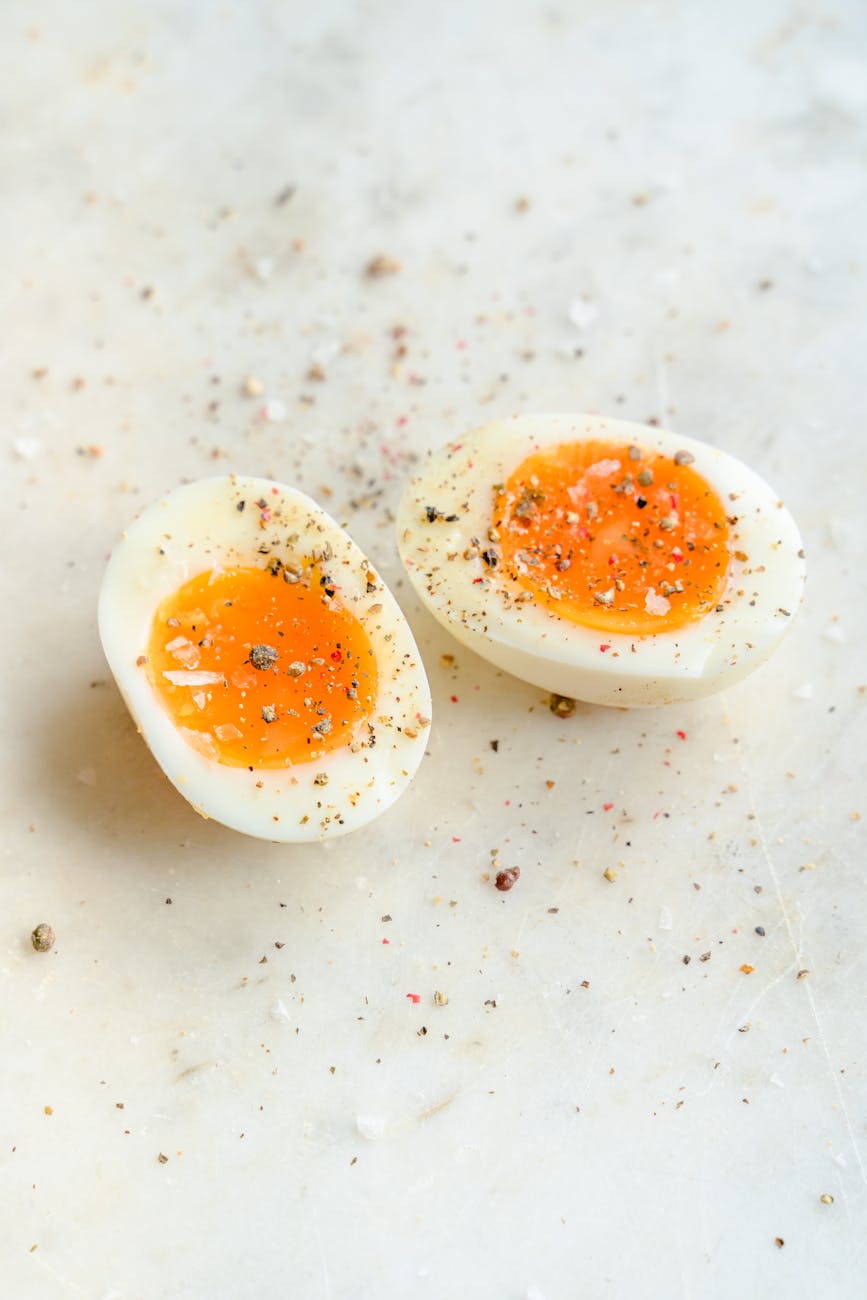
Lu: Everything solidifies basically, right? So how does that happen? So eggs are around 15% protein, and all proteins are basically long strings made of amino acids that twists and folds onto itself to form this 3D structure. And proteins twist and fold because parts of the string are sticky and want to stick to each other. So in a raw egg, each protein is folded in a fairly specific way to give them a more or less precise 3D structure. However, when an egg is hard boiled, the heat basically completely destroys the 3D structure of the proteins by untwisting and unfolding them. Now, because all of the unfolded proteins are surrounded by other unfolded proteins, they start sticking to each other because they’re still sticky. And when they all start sticking to each other, they form clumps. And that’s what causes the egg to solidify. So, Tirth, the question is, can you unboil an egg? It would be very hard, right?
Tirth: Like you had to separate the protein clumps…
Lu: And refold each individual protein.
Tirth: …and individually find every protein and order it? Although, you know, the King’s Men, they did this. They did put Humpty Dumpty…Actually, they tried putting them back together and even they couldn’t.
Lu: But Tirth, what if I told you that some scientists have successfully unboiled a hard-boiled egg?
Tirth: Wow, I would say using the razors from the intro to this episode, that’s an extraordinary claim. And I would need to see extraordinary evidence.
Lu: Yes. Good, good. Very good scientist. So the study is titled, “Shear Stress Mediated Refolding of Proteins from Aggregates and Inclusion Bodies.” It was published in 2015 in the journal ChemBioChem.
Tirth: ChemBioChem?
Lu: Yeah, which is a good journal. It turns out, it’s actually fairly easy to unboil an egg.
Tirth: Is that right?
Lu: Yeah. So remember, in a hard-boiled egg, all the proteins are clumped together. It turns out, if you just undo those bonds that they form with other proteins around them, and you remove the heat source, the proteins will actually start to refold.
Tirth: On their own?
Lu: Yeah. But the trick is, how do you separate the unfolded proteins from each other? So what this group figured out is, there’s a couple of things you can do. First, what they did was they took egg whites, and “heat treated the egg whites for 20 minutes at 90 °C.” Basically, they hard-boiled the egg. And then they did two things. The first thing they did was use a chemical called urea to help undo some of the bonds that’s holding the protein clumps together, undo some of the stickiness. And this by itself actually turns the boiled egg whites back into a liquidy form. And second, apply shear stress by vortexing the liquidy egg whites. The idea here is that you’re physically shearing the different proteins in the clumps apart physically. Literally tearing the proteins apart from each other. So, they just did these two things and found that they can unboil the egg. But what’s the evidence that the egg is unboiled? You earlier asked for extraordinary evidence, right? So, if the egg is truly unboiled, then the proteins should regain their nice orderly folded structure. Now, some of the egg proteins are enzymes, which catalyze chemical reactions, and are only functional when they’re in their nice, orderly folded structure. So, they tested the function of one of these egg enzymes, and guess what? Just by treating the boiled egg whites with urea and then vortexing it, they were able to recover 82% of the enzyme activity.
Tirth: Wow. Well, why not just take the egg and crack it in a pan and see if they can make an omelet? That would be the ultimate test to see if it was unboiled.
Lu: How would that test whether the egg is unboiled or not?
Tirth: Well, because when you make, let’s say, you make scrambled egg whites, right? You take an egg, you crack it. Let’s say you take the yolk out. Now you got to scramble the egg whites. You can’t do that with boiled egg.
Lu: Oh, is that extraordinary evidence though, Tirth?
Tirth: No, but it would be fricking cool.
Lu: Please, Tirth, check yourself before you wreck yourself.
Tirth: Because listen, it could just be that this one enzyme is hardy enough, right? Different enzymes are resistant to all…
Lu: They didn’t check every single enzyme, but as a proof of concept it’s a pretty, pretty cool finding. 82% of the activity recovered, that’s very good. After boiling the egg for 20 minutes.
Tirth: Yeah, that’s pretty impressive.
Lu: So final thoughts?
Tirth: I like the study. I wish they could have done a little bit more. Maybe there’s some other follow up studies to this out there, I’m not sure. And I would like to know why did they do this? Just because?
Lu: Very good question. Well, I think as scientists, you know, sometimes we feel like gods, right? We want to want to test our capabilities.
Tirth: Uh-huh.
Lu: We want to see if we can…
Tirth: Like cloning a sheep or unboiling an egg.
Lu: Yeah. Or undoing entropy, right? Reversing time itself.
Tirth: Yeah. Makes you feel…
Lu: I would argue on some level they did reverse time. But the real significance here, actually, this has a very practical purpose. I’m glad you asked this question. So protein manufacturing, very important for research for science, but also for industry, like medicines. So insulin is a protein. And the way we manufacture insulin is we get bacteria to make it for us. So we introduce the piece of gene that makes insulin into a bacteria, and the bacteria makes the protein, and then we extract the protein.
Tirth: It used to be we used to get it from pigs, I think.
Lu: Yeah.
Tirth: It used to be, and then this revolutionized it.
Lu: yeah, recombinant… But there’s a problem with this. When you’re introducing a foreign protein, foreign DNA/protein, to the bacteria, and you’re overexpressing it because you want the bacteria to make a lot of it, the protein can often misfold and clump together, as if it were like boiled.
Tirth: Because it’s not in its native environment.
Lu: It’s not in the native cell. And there’s a lot of it, much more of it than normal.
Tirth: Yeah.
Lu: This is a big problem in the protein manufacturing industry. This is one potential solution to untangling that aggregate of protein, that clump of protein, and letting it re-form to make functional protein.
Tirth: Nice. Nice. Okay. Very nice.
Lu: All right, Tirth. That’s it for me.
Tirth: That’s it for you. It’s my turn now.
Synesthesia or LSD?
Tirth: Before I get into my paper, I have a question for you. Can you explain to our listeners or viewers what synesthesia is?
Lu: It’s a good question. Synesthesia, if I believe correctly, is supposed to be a thing where people get their senses confused. Or the senses cross streams, let’s say.
Tirth: Yes. There you go. Yeah. Cross streams.
Lu: So one manifestation of this is seeing colors when you hear sounds. And I believe if you go online and go on like Reddit or whatever, there’s specific colors associated with specific sounds. So like certain people, the C note might be specifically associated with yellow. And that’s true for a lot of people.
Tirth: So the technical term is cross modal representation, because it’s different sensory modes that are representing the crossing in the brain.
Lu: Crossing the streams.
Tirth: Crossing the streams, yeah. Speaking of synesthesia, Richard Feynman, a scientist that you and I have talked about on and off the pod, claims that he used to see math equations in color.
Lu: That’s not synesthesia. Those are hallucinations. He’s on LSD.
Tirth: He was on LSD, that’s true.
Lu: He was absolutely on LSD.
Tirth: That probably explains it better.
Lu: That is not synesthesia.
Tirth: So anyway, as you may have guessed, today’s paper is related to this topic of cross modal representation.
Lu: Very good.
Tirth: Here’s the title, “As Bitter as a Trombone: Synesthetic Correspondences in Non-Synesthetes between Taste, Flavors and Musical Notes.” There’s a lot of words here, fancy words here. I’ll break it down.
Lu: Okay, please.
Tirth: What they’re basically saying is that they looked at synesthesia type correspondence in people who specifically said that they did not have synesthesia.
Lu: So, they’re trying to see if these guys can make the same color and sound associations, for instance.
Tirth: Right. Except they went a step further and they’re comparing sound and taste or flavor of different types of food items.
Lu: I see. So, if you play a sound, can you like change the flavor of the thing they’re eating?
Tirth: Or more it’s like, let’s say you’re given a certain flavor to taste and we play different sounds, do you associate certain types of flavors with certain types of sounds more?
Lu: Okay.
Tirth: And they also tested the reverse where if you play, you know, certain instruments, do you associate certain instruments with more pleasant flavors or more bitter or unpleasant flavors? This was published in the journal Attention Perception and Psychophysics.
Lu: Oh, that’s a great journal.
Tirth: Great journal. In the year 2010. The authors are from the University of Oxford in England.
Lu: Nice.
Tirth: So like I said, they wanted to test if there’s a relationship between flavors and pitch of different instruments. So the way they set this up is they had 34 participants…
Lu: None of these guys have synesthesia?
Tirth: No. Yeah, they asked.
Lu: But how do they confirm that?
Tirth: I mean, I think it’s just…
Lu: What if they don’t know?
Tirth: Yeah, I guess that’s possible.
Lu: What if they’ve never tested themselves?
Tirth: That’s possible. That’s good…yeah. So already, already, that’s one potential criticism. For flavors, they had 12 different flavors. These were split into five basic tastes. So bitter, sour, sweet, salt and umami.
Lu: Very good.
Tirth: And they had more complex flavors. So almond, coffee, lemon, orange flower, peppermint, rose, and vanilla.
Lu: Which are just smells, right? Those are basically just smells on top of taste.
Tirth: Correct, correct. So that’s why they’re calling them flavors. So it’s like taste plus flavor.
Lu: …plus smell is flavor.
Tirth: Yeah, because as we all know, taste and smell are intricately linked.
Lu: Very good. I participated in similar experiments during my psychology days in undergrad.
Tirth: You did?
Lu: So yeah, they gave me something to smell. I couldn’t smell it and they told me to go home. I was not the right person for the experiment.
Tirth: Well, so you didn’t receive credit. You probably would have been excluded from this because they said they selected people, if they said they couldn’t smell or they took too long to choose instruments, they were sent home. Or if they had a cold, they were sent home. They did not pick people with colds.
Lu: Maddening. I went on campus that day. It was a Saturday morning, I wasn’t going to go on campus otherwise. Went there just for the experiment. Sent home.
Tirth: They wasted your time.
Lu: I was so mad. Yeah, so mad.
Tirth: So that’s criticism number two?
Lu: Criticism number two. Yeah.
Tirth: Okay. So because they wanted to test flavor versus pitch, they chose four different musical instruments, piano, strings, woodwind and brass, and 13 different tones. Now you’re a music guy, so you’ll probably understand this more. The pitch of the notes ranged from C2 to C6. So in total, they had 52 different sounds. So 13 notes times 4 instruments.
Lu: Are these recorded sounds, or do they get live musicians to come in?
Tirth: They did not get live musicians. These are recorded sounds.
Lu: I see. Okay.
Tirth: They should have gotten the orchestra though. Like the Royal Philharmonic. It’s like, “hey, come on over. It’s a Saturday.” That’s too good, man.
Lu: Yeah.
Tirth: So then they had each person sit down. They had them do the taste for the 12 different flavors.
Lu: Like one at a time?
Tirth: Yeah. So they had them do one, then they said, okay, wash your mouth. Then the people were allowed to listen to any sounds they wanted for however long they wanted on the computer. Any of the 52 different sounds.
Lu: Okay.
Tirth: And they had to pick one. They had to say, this flavor, in my mind, associates most strongly with this sound.
Lu: I see. Okay. After they taste one of the flavors, they had to play 52 sounds from the computer and pick one.
Tirth: They don’t have to, yeah. They could just pick the first one. Like this is it.
Lu: Oh, that’s what I would have done, if I was a participant. Pick one at random.
Tirth: They did a lot of statistical, very rigorous statistical testing on the back end to exclude for things like that. But anyway, so that’s the first try. They actually did this twice. So they had them do the same flavor twice. They had them do the first round and they randomized the order. They had to do the second round. They also compared to see if they picked the same sound the second time with the same flavor.
Lu: Okay, so they’re looking for consistency within the same subject.
Tirth: Correct.
Lu: And also obviously across the subjects, but also across the different subjects.
Tirth: That’s correct. And then I will mention this, although I’m not going to go into too much detail, is that separately, they also had each participant rate the complexity and the intensity profile and the pleasantness of the flavors. And then separately, there was a second experiment where they just listened to the sounds and they rated the sounds in terms of complexity, pleasantness and intensity.
Lu: All 52.
Tirth: Yes. The goal of that was to see… So for example, let me use concrete examples. Let’s say if one person or let’s say majority of people had rated vanilla as pleasant, they wanted to see, was there a musical instrument or a sound from a musical instrument that most people had also rated as pleasant?
Lu: Also preferred.
Tirth: Correct. Before I get into some of the results here, do you want to guess? Let me ask you a series of questions, okay?
Lu: Okay.
Tirth: First of all, you mentioned that you would have picked randomly. Do you think most people picked randomly or do you think that there was some non-random selection going on? Meaning, let’s say, let’s use concrete examples. If one person had tasted vanilla and associated vanilla with low pitch piano, do you think they would have done the exact same thing with the second sip of vanilla? Or are they more likely to have chosen something else?
Lu: I think they probably would have just chosen something else.
Tirth: Okay. All right. Fair enough.
Lu: For a lot of the people.
Tirth: So the association is not that strong, but statistically it was still significant. So they had 34 participants each do 12 flavors. So the total number of trials was 34 times 12, which is 408 trials. Out of those 408 observations, 11.3% of the time, they successfully matched the flavor to the pitch and the instrument the second time.
Lu: Okay.
Tirth: But here’s a more stronger piece of evidence. Now they also tested, hey, are our participants at least able to match the instrument, the same instrument? You want to guess the percent this time?
Lu: Well, so I guess the chances of that matching the instrument would be one out of four, right, for each trial.
Tirth: That’s random. Yeah.
Lu: That would be random. So let’s say, okay, I’ll give them a little bit higher than random. I’d say 35%.
Tirth: 41%.
Lu: 41%. Pretty good.
Tirth: Yeah. Pretty good. I agree. The next obvious question is, well, you have all this data, you have all these different instruments. Can you see if there’s one instrument or one type of instrument that’s consistently associated with one specific type of flavor?
Lu: Okay.
Tirth: And turns out that yes, the answer is yes. It turns out that brass or trombone or other types of brass instruments are more consistently associated with more extreme flavors. So like slightly more bitter flavors and sour flavors. And on the flip side, the piano is associated more with sweeter, more pleasant flavors. So sucrose, almonds, rose, vanilla.
Lu: I can see that. Makes sense. But I mean, so for the first study where they looked at whether people consistently chose the same sound to go with the same taste. Aren’t they just checking for people’s memory? Like some people just remember the first time what sound they chose for that flavor. And then the second time…
Tirth: I mean, you would hope so. You would hope so.
Lu: So that could potentially just be explained by people’s memory and wanting to be self-consistent.
Tirth: Yeah, partially.
Lu: Cool. So what’s the takeaway?
Tirth: The takeaway message here is synesthesia can present itself in people who don’t even know they’re synesthetics, and more practically speaking, there’s advertisers and marketing people can take notes and sell food products, you know.
Lu: I see.
Tirth: For example, if you’re selling cereal, maybe you want to, the background music should be a piano. Or if you’re selling coffee – like if you’re Starbucks, you know, you should be playing the trombone as loudly as you can. Maybe hire a live person.
Lu: That will maybe enhance the bitterness of the coffee, which some people like. I know you take your coffee black.
Tirth I do
Lu: But for more refined people who like to add a little sugar, a little cream to their coffee, bring out the sweetness, maybe you want to play some piano in the background.
Tirth: Yeah.
Lu: I see. I see. But is this really synesthesia, though? Or is this just people associate one thing with another because they have similar qualities?
Tirth: Yeah, I agree. I think that’s a… I think they would say that that’s an example of synesthesia.
Lu: Okay. Whereas I think maybe a more rigorous definition of synesthesia would be if you play a sound, do people have a specific taste in their mouth?
Tirth: Yeah, that would be a very strong effect.
Lu: Or if you taste a specific flavor, do you hear a specific sound in your ears, even when it’s not playing?
Tirth: Without it being played to you. I agree. I think that would be a very much stronger result.
Lu: Here’s how I would improve the study. I would give each of the participants a couple of drops of LSD right before the study. Boost the brain a little bit. Boost the random free association parts of the brain, and then do this.
Tirth: And then do this, yeah…
Lu: Okay, Tirth, good stuff. Anything else?
Tirth: Thank you. Nope, that’s it.
What did you learn today?
Lu: Tirth, what did you learn today?
Tirth: Lu, I learned today that if I want to control and reverse time and de-age myself…
Lu: Okay. Which would be useful. I see a little gray in your beard.
Tirth: Yeah. There’s a lot of gray, a lot of gray. People call me silver fox, but it’s okay. I would stuff myself in a giant centrifuge tube and vortex myself.
Lu: Oh, beautiful.
Tirth: All I have to do is find a vortexer large enough and a tube large enough.
Lu: I would love to be there when you try that.
Tirth: What did you learn today?
Lu: I learned that the next time I go to the symphony, because you know I’m a cultured man. I go to these all the time. I should bring my own charcuterie board to taste along with the music, figure out if I’m synesthetic.
Tirth: Yeah, not just you. Also, you’ll share it with the other patrons. They’ll enhance all their experiences.
Lu: No, no.
Tirth: Oh, just you. You don’t need for others…
Lu: Yeah, please.
Tirth: I see.
Lu: Okay, guys, thanks for listening to our show. Hope you enjoyed this episode.
Tirth: And if you like listening to us, please subscribe, leave us a good review on whatever platform you follow us on and tell a friend. That’ll help us out a lot.
Lu: All right. Take care.
Tirth: Bye.