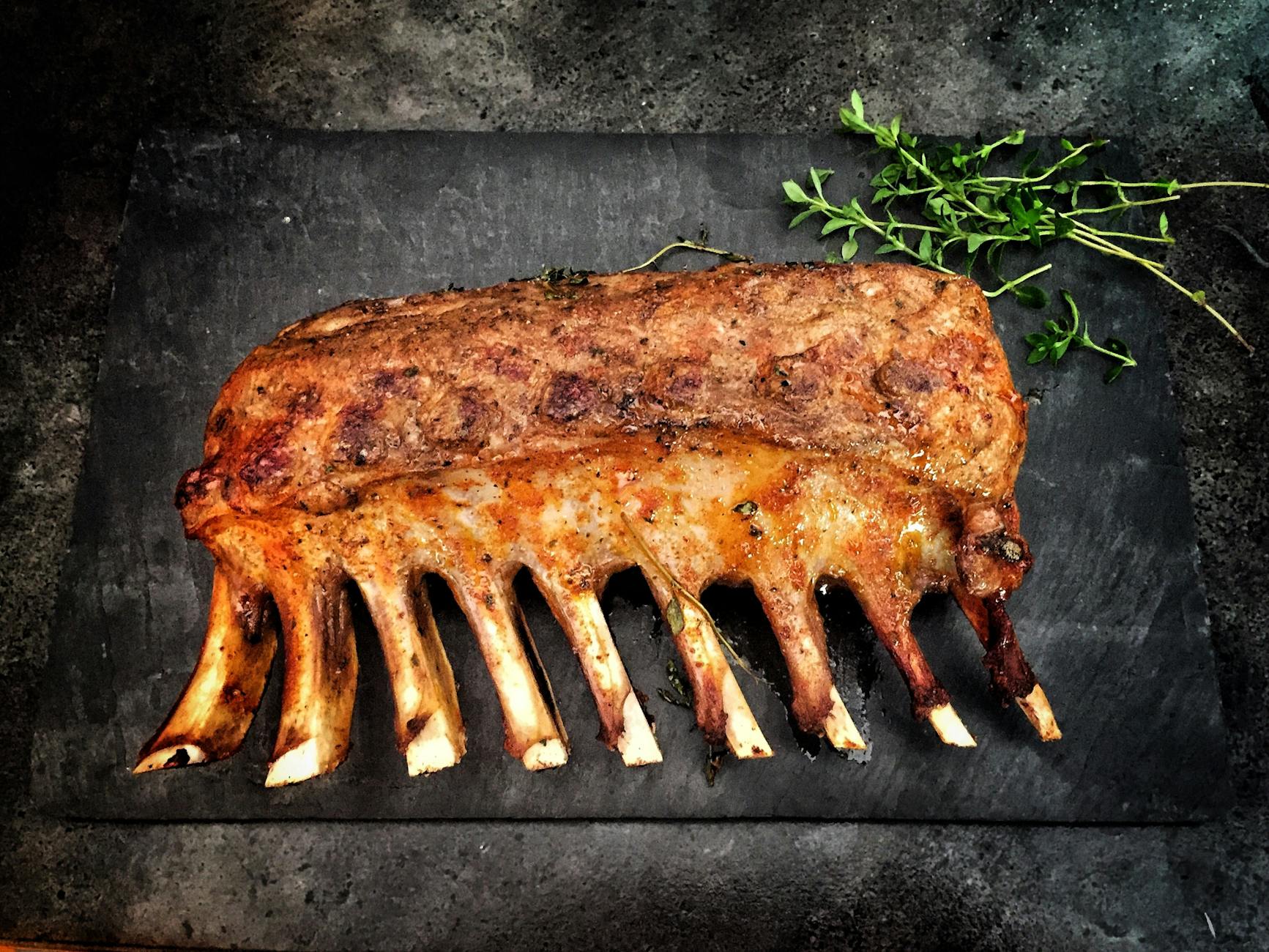
To some people, eating meat is immoral. That’s a subjective opinion. However, does eating meat make you immoral objectively?
Some scientists fed beef to college students and found that afterwards, the students developed quantifiably more immoral opinions of cows. Lu and Tirth discuss this meaty study on S01E05 of the Recreational Science podcast (timecode 13:39):
Lu: The title of this study is “The role of meat consumption in the denial of moral status and mind to meat animals”. This was published in 2010 in the journal Appetite, which is a fantastic journal.
Tirth: Which I assume is a great journal.
Lu: Fantastic journal. This is by a group from the University of Kent in the UK.
Tirth: Mhm, great place.
Lu: So I have a question for you, Tirth. Do you enjoy eating meat?
Tirth: Yes, I do.
Lu: And do you enjoy harming or killing sentient creatures?
Tirth: Uh, no, I don’t.
Lu: Ah, well according to the authors, you’re in the majority of people. You love the taste of meat, but you don’t want to kill animals to get the meat.
Tirth: Mhm.
Lu: So what can you do? Well there are three options: option #1 is to stop eating animals; option #2 is fail to recognize that animals are killed to produce meat; and option #3 is to suppress your moral concern for the animals when you eat meat.
Tirth: Yes.
Lu: The experimenters wanted to test if option #3 is true. To conduct the study, they recruited 108 participants. The goal is to give participants meat or a non-meat control, and then see how eating the meat affects how the participants feel about animals and whether or not they think animals deserve moral treatment. But you can’t just give the participants meat and then ask them, hey, how do you feel about pigs or cows or whatever, right?
Tirth: Right.
Lu: Because the participants will know something’s up and figure out the purpose of the study, which will affect how they respond. So here’s where the genius comes in. The participants they recruited were students in a psychology class, and as part of the class, they needed to participate in a study to receive class credit. Specifically they had to participate in a 30-minute study. So the experimenters told the students, the participants, that this is a study of food preferences, which just means that they’re going to get food to taste, but that’s only going to take 5 minutes of their time. So, to fill up the remainder of the 30 minutes they needed to receive full class credit, they’re going to be given an “unrelated” questionnaire, just to fill up time and cheat the system for credit.
Tirth: Okay.
Lu: But, as you might have guessed, in reality – and this is a direct quote from the paper – “the food tasting task was the experimental manipulation, and the additional questionnaire is the dependent variable.” So in the food tasting task, the participants were randomly assigned to taste either beef jerky or cashew. And then the “unrelated” questionnaire is a questionnaire on animals.
Tirth: Okay.
Lu: For this “unrelated” questionnaire, the participants were presented with 27 non-human animals and were asked to indicate which animals they felt morally obligated to show concern for. Then they were told that one of the 27 animals will be randomly chosen for a more detailed assessment. But in reality, the randomly chosen animal was always the cow. The participants were then shown an image of a cow in a paddock and asked two questions: 1) how much does this cow deserve moral treatment? And 2) how unpleasant would it be to harm this cow? And then the participants rated the cow’s sensual and cognitive abilities, including their ability to see, hear, taste, feel pain, hunger, pleasure, fear, happiness, and rage, and then also their ability to think, imagine, wish, need, desire, intend, plan, choose, and reason.
Tirth: Mhm.
Lu: Any problem with their methods?
Tirth: Wow. No, no, it’s all very sound. No complaints.
Lu: Bulletproof study. So here are the results. In terms of the first task, which is selecting which of the 27 animals the participants feel moral concern for, participants who ate the beef jerky beforehand selected 13.5 animals on average, whereas participants who ate the cashew selected 17.3 animals. Four more animals.
Tirth: Mhm. Okay. Four animals more.
Lu: That’s like 30% roughly more. And in terms of the question, does a cow deserve moral treatment? The beef jerky participants rated the cow as less deserving of moral treatment. They rated the cow as, on a scale of 1 to 7, a 5.57. The cashew participants rate of the cow a 6.08, so slightly higher.
Tirth: Mhm, slightly higher.
Lu: However, on the third task, which is rate the cow’s sensual and cognitive abilities, there was no difference. But I would argue that’s a pretty ridiculous task to begin with.
Tirth: Yeah. I don’t know how you would…
Lu: So this study showed that after eating beef, people generally felt less moral concerns for cows. But I have a question.
Tirth: Yes, go ahead.
Lu: Is a problem? I would argue this is not necessarily a bad thing. Because if you’re going to eat meat, you want to make sure you don’t feel bad afterwards, right?
Tirth: Right I mean, from an appetite standpoint. I actually have one question: where do you draw the line? Most people agree that trees are alive – I have some doubts about it, but that’s a different story – but we eat a lot of plant material, right? We use it for everything. I wonder if they extended the survey to…do you feel moral concern for plants?
Lu: I see where you’re getting at. So if you were given a task of rating your moral concern for the abilities of trees to to feel and think, would that be higher or lower than the ability of cows to feel and think?
Tirth: Oh, lower, no question, man.
Lu: But you’re asking, where do we draw the line?
Tirth: Well, I guess you wouldn’t because you don’t even think this is a problem.
Lu: No, not a problem. Eat whatever you want.
Article citation
Loughnan et al., 2010. The role of meat consumption in the denial of moral status and mind to meat animals. Appetite. https://www.sciencedirect.com/science/article/abs/pii/S0195666310003648?via%3Dihub






Leave a Reply