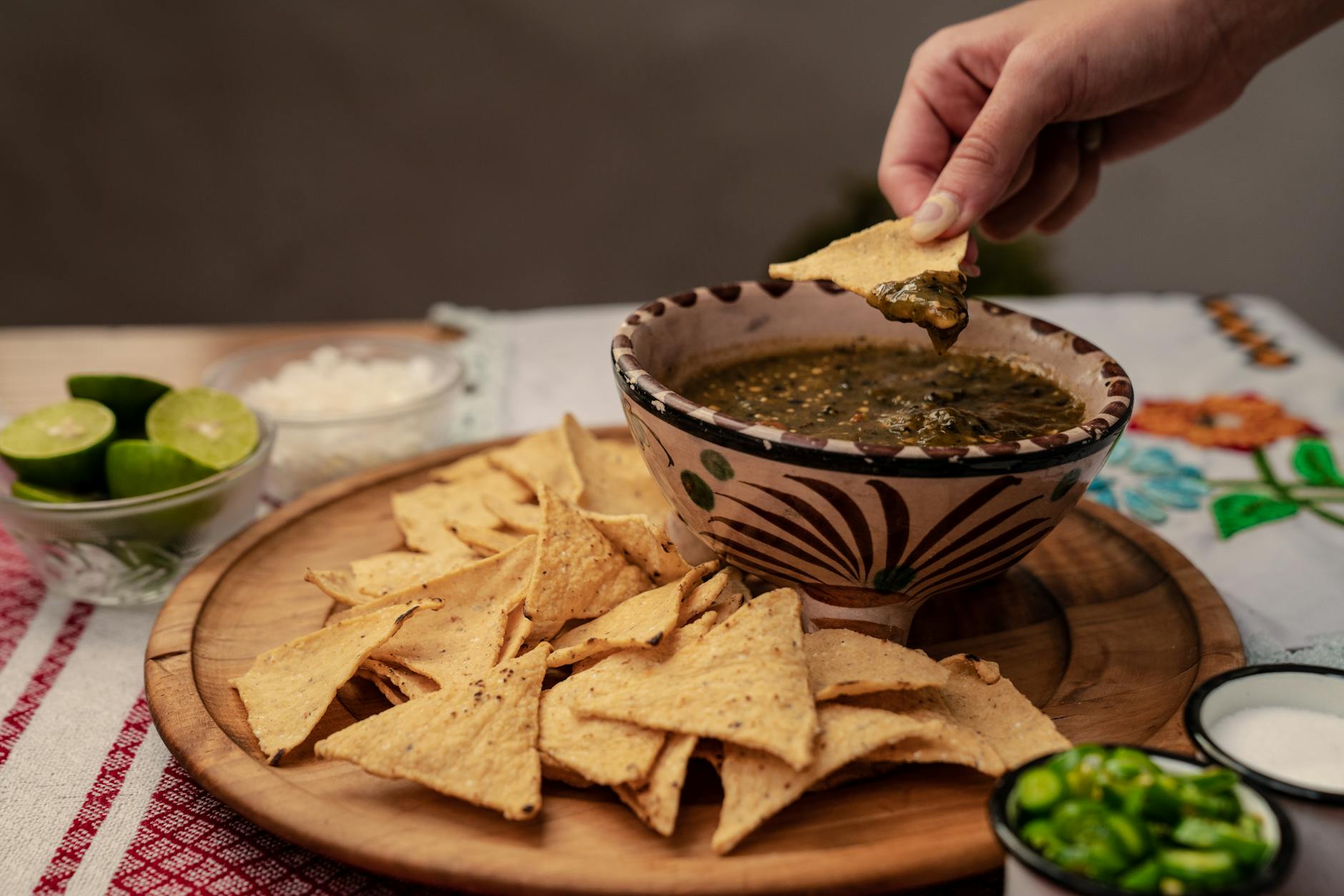
Why is double dipping frowned upon? Does it transfer oral bacteria from the chip to the dip? Does it transfer enzymes from your saliva to the dip causing unwanted pre-digestion? That would be gross.
In the first study, some microbiologists and food scientists investigated whether double dipping actually contaminates various dips with oral bacteria. In the second study, a food blogger investigated whether saliva transferred through double dipping breaks down the dip. Lu and Tirth discuss these George Costanza-shaming studies on S01E06 of the Recreational Science podcast (timecode 18:18):
Lu: Tirth, you’re a well-known double dipper. Is that correct?
Tirth: It’s actually correct. I don’t know who snitched, but this is true.
Lu: Why do you do it?
Tirth: It’s more efficient.
Lu: To dip twice?
Tirth: Yeah, you’re not wasting that many chips, you’re not wasting that much salsa, right?
Lu: Okay. So this is an economical decision. It’s not out of poor planning and inconsideration for other people.
Tirth: No, no, no. I see nothing wrong with double dipping.
Lu: Ah, well this study that I’m going to present to you might prove you wrong.
Tirth: Okay. Let’s see.
Lu: The title of the study is “Effect of Biting Before Dipping (Double Dipping) Chips on the Bacterial Population of the Dipping Solution”. This was published in 2009 in the Journal of Food Safety. Which is a very good journal.
Tirth: Great journal. Food safety is a very important subject.
Lu: So double dipping, a term popularized by an episode of Seinfeld. George Costanza was asked politely not to dip his chip into the salsa after taking a bite. He refused…
Tirth: He threw a fit.
Lu: But does double dipping actually increase bacteria contamination of the salsa you’re dipping? To answer this, the experimenters asked a few dippers to dip low sodium Wheat Thins into various dips. The dippers held the cracker with sterilized gloves, dipped for three seconds, three times. That’s a total of nine seconds worth of dipping, with or without having bitten into the cracker. The experimenters then cultured the dip to look for bacteria. Overall the study consists of three different experiments. In the first one, they just dipped the crackers into sterilized water.
Tirth: Okay.
Lu: They found a much, much higher bacterial population in the dip when the dippers took a bite before dipping. Double dipping resulted in 2,600 colony forming units per milliliter of the water they dipped into. Colony forming units (CFUs) is basically how many bacterial colonies they found per milliliter of the dip. Without double dipping, it was only 10 CFUs. 2600 versus 10. Big difference.
Tirth: Pretty big difference.
Lu: Very big difference. You feeling good about yourself so far, Tirth?
Tirth: Oh, so far yes. I believe I’m making people more immune. I’m helping their immune system by giving them my good oral bacteria.
Lu: I see. Next, the experimenters had dippers dip the Wheat Thins into three different dipping solutions. They’re all water still, but they have different pHs. So normally water is pH 7. Here they use pH 4, 5, and 6.
Tirth: So pretty acidic.
Lu: And the reason they chose 4, 5, and 6 is that these pHs correspond to some of the more popular dipping sauces. pH 4 corresponds to the pH of salsa. pH 5 corresponds to the pH of chocolate sauce. pH 6 corresponds to the pH of cheese, a cheese dip.
Tirth: Okay. All right.
Lu: With all three pHs, there is increased bacterial growth with double dipping than without.
Tirth: Even in pH 4?
Lu: Even in pH 4, the most acidic pH, although the bacterial growth was lower than in pH 5 and 6.
Tirth: Somewhat surprising, but okay.
Lu: Next, they experimented with real dips: salsa, chocolate sauce, and cheese sauce. They found that across all three of these dipping sauces, double dipping led to 600 CFUs of bacteria in the dip, whereas no double dipping led to less than 10 CFUs.
Tirth: Okay. Still a pretty big difference.
Lu: Over 60x difference. But here’s the interesting thing. There was actually a higher bacteria count in the salsa compared to the cheese and the chocolate.
Tirth: Even though it’s acidic.
Lu: The salsa is pH 4.
Tirth: Right.
Lu: So this is contradictory to their second experiment. The more acidic dip somehow had more bacterial growth. Do you have any hypotheses on why this might be?
Tirth: Maybe there’s more surfaces in the salsa. The surface area is higher.
Lu: Yeah. I think you’re on the right track. So the hypothesis they put forward is that salsa is not as viscous as the chocolate and the cheese sauce. So when you dip into the salsa, the bacteria spreads quickly into the salsa, and you don’t carry a lot of it back with you.
Tirth: Back up into your mouth again.
Lu: Exactly. But with cheese and chocolate, because they’re so viscous, you dip the bitten chip into it, bacteria goes from the chip into the nearby chocolate, but then the nearby chocolate just gets picked up again because it’s so viscous and sticks to the chip. That’s their hypothesis.
Tirth: Seems believable.
Lu: So in conclusion, double dipping contaminates the dip with bacteria. Tirth, you writing this down?
Tirth: No, no. I don’t need to write it down. I just want to add once again, maybe I’m just spreading good microbiome bacteria to everyone else at the party. Maybe they should be thanking me.
Lu: I see. Well you actually bring up a good point. Double dipping transfers bacteria to the dip, but is this really harmful? Well, in most cases, probably not. Oral to oral transfer of microbes is not likely to be pathogenic, except in certain cases, like norovirus, right? That’s the one case where you don’t want to double dip.
Tirth: No, right.
Lu: So you should get yourself checked for norovirus every time you go to a Mexican restaurant. But even that doesn’t get you out of the woods, Tirth.
Tirth: Oh.
Lu: There’s an article on Serious Eats that says there’s something more important about double dipping that affects the food than just bacteria contamination. The hypothesis is that amylase in the saliva can actually break down the dip before it reaches your mouth. So Tirth, what is amylase?
Tirth: Amylase is an enzyme that’s found in your saliva. It breaks down, I think, a lot of like starches and carbs.
Lu: Yeah, exactly. The author of this article, which is called “The Surprising Reason You Shouldn’t Double Dip”, is Switha Sivakumar. She tested a few different foods that were thickened with starch, which includes oatmeal, cream of mushroom soup, and cream of potato soup. In addition, she also tested cheese sauce and a creamy mac and cheese. For her experiment, she licked a spoon and then dipped the spoon into these different foods. Interestingly, when she did this, the oatmeal, cream of mushroom soup, and cream of potato soup all noticeably thinned after 15 minutes.
Tirth: Wow.
Lu: The viscosity of the starchy foods went way down, presumably because the amylase in her saliva is breaking them down. And that’s sad because, you know, when your cream of mushroom soup is not creamy, what do you have? You just have mushroomy water.
Tirth: Yeah…
Lu: The cheese sauce and mac and cheese did not thin, presumably because their thickness comes from protein, rather than starch.
Tirth: Interesting. But I’ll say this, salsa is already a low viscosity dip.
Lu: True, it’s low in starch.
Tirth: Yeah. I’m not concerned. Again, I’m doing them a favor.
Lu: I see.
Tirth: First of all, just by being there, my presence is a gift.
Lu: Oh, is that right?
Tirth: Yeah, of course. You and I have been to many parties together. So, you know this.
Lu: You often get booed and people seem to enjoy booing you. So, in that sense, I think you do contribute a lot to people’s enjoyment at parties.
Tirth: Please, they’re actually saying, “good, good”.
Lu: Oh, is that right? I gotta listen more carefully. That’s my bad.
Article citation
Trevino et al., 2009. Effect of biting before dipping (double-dipping) chips on the bacterial population of the dipping solution. Journal of Food Safety. https://onlinelibrary.wiley.com/doi/10.1111/j.1745-4565.2008.00137.x
Sivakumar, 2025. The Surprising Reason You Shouldn’t Double Dip (It’s Not Just Germs). Serious Eats. https://www.seriouseats.com/science-behind-double-dipping-8787002





Leave a Reply