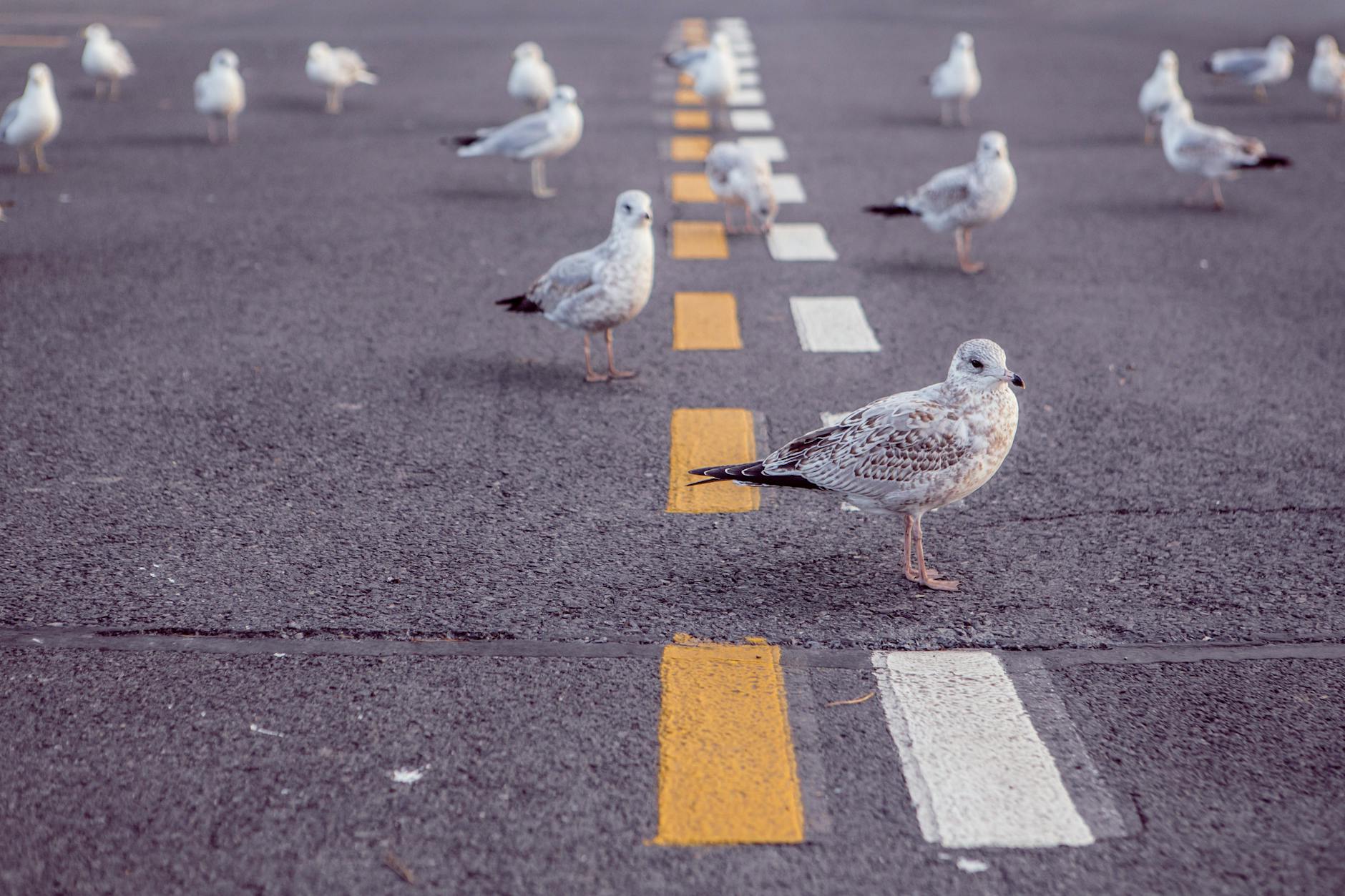
Why do some animals get hit by cars? Are they just dumb? A taxidermist with a collection of 3500 dead birds teamed up with a zoologist to determine whether birds killed by cars have smaller brains. Lu and Tirth discuss this taxing study on S01E10 of the Recreational Science podcast (timecode 28:04):
Tirth: The title of the study is, “Brain size in birds is related to traffic accidents.” This was published in the journal Royal Society Open Science.
Lu: Oh, good journal.
Tirth: Great journal. Great journal. So, get this, a quarter of a billion birds are killed by traffic annually across the world.
Lu: That’s interesting. Like they’re just flying into the windshields of cars?
Tirth: Right. Right.
Lu: I’ve never had that happen to me.
Tirth: Me neither. But apparently the number is very high.
Lu: I didn’t know birds flew that low.
Tirth: Or maybe they’re hanging out on the road, like eating, you know, pigeons do that sometimes. The car just hits them.
Lu: And you assume they’ll fly out of the way, but sometimes they don’t.
Tirth: Sometimes they don’t. The researchers of this study found this surprising because birds have been shown to learn speed limits and traffic patterns.
Lu: They learn to read the speed limit sign?
Tirth: Yeah, they’re very smart birds. Some birds are very smart.
Lu: Birds are smart, I agree…
Tirth: So they wanted to know, given that some birds are so smart, why are they getting killed by cars? So, a previous study found a relationship between brain size in birds and getting shot by hunters.
Lu: I’m assuming this is a negative correlation.
Tirth: Yes, yes. So the smaller their brain, the more likely the birds are going to be shot by a hunter.
Lu: Or killed by a car…
Tirth: So that’s exactly what this study is asking. Is this true for car accidents also?
Lu: I see.
Tirth: So one of the researchers, a taxidermist, collected almost 3500 dead birds over a period of 45 years. I think this is his specialty. And he’s able to identify based on autopsies how each bird died. The 3500 birds died of all sorts of different causes. Some of them got hit by cars, some of them were shot by hunters, and some of them just died of old age, probably. So they weighed the brains of these dead birds to see if those that died by car accidents had smaller brains than those that died if all other causes.
Lu: Okay, so they’re able to pretty reliably tell whether a bird got hit by car or the bird like flew into a wall?
Tirth: So that’s the claim they’re making. And then the question they asked is, is there a relationship between brain size and the likelihood of dying by getting hit by a car?
Lu: Right, okay.
Tirth: Since birds come in different sizes, they actually normalized the brain size to body size, so that they can compare across individual birds and species of birds.
Lu: When scientists usually compare brain size between species, this is sort of the metric they use, right? It’s all relative to body size.
Tirth: Yeah, it has to be. So, what do you think the result was?
Lu: I’m guessing the birds killed by cars were more likely to have smaller brains?
Tirth: Yep. For each unit of increase in brain mass, birds were 30% less likely to die by getting hit by a car.
Lu: Wow.
Tirth: The roadkill birds had brains that are roughly 15 to 25% smaller than others with the same body mass.
Lu: Okay, very interesting. I have one criticism, which is there’s really no denominator, right? Meaning they didn’t look at the prevalence of the species of birds, for instance, in the setting that they acquired the birds from. Maybe the birds that were killed by car traffic were more prevalent along road sides than birds that died in the woods. And maybe birds that hang out by road sides have smaller brains for body size for another reason.
Tirth: Another reason, right, right, right.
Lu: So I think controlling for species will control for this prevalence confounder.
Tirth: I agree with you. I think it’s more powerful when you’re just looking at one species.
Lu: So I guess the take home point from this is, dumber birds are more likely to be killed by traffic?
Tirth: Yes, yes.
Lu: Because they can’t judge the speed limit…
Tirth: The speed and the direction of the cars. They can’t react fast enough.
Lu: They can’t read the speed limit sign.
Tirth: That’s right. That’s right.
Article citation
Moller et al., 2017. Brain size in birds is related to traffic accidents. Royal Society Open Science. https://royalsocietypublishing.org/doi/10.1098/rsos.161040







Leave a Reply